Showing posts with label West Palm Beach. Show all posts

Sunday, December 29, 2013

Holiday Fashions: Part 2


As I previously discussed, we held our annual firm Christmas party this month. And as I said in my previous post, I planned the outfit over a couple of months.  No I didn't buy my dress in September, but I did weigh my color and my styling options. 

Ultimately, I decided to go with a blue dress from H & M because blue is my color for the season. Additionally, I pulled out a pink/nudeish necklace that gave my outfit some dazzle.  This left me with the option of nude for my heals.  I completed the look with a nude headband, that I spruced up with a gold headband with a bow and some bling.  I kept my earrings small and nude, since I was already rocking a giant necklace and wearing hair accessories.  Oh yea, and no jacket! What do you think about my south Florida holiday wear? 

Many of the guests were in cocktail wear, however there were a few who decided to go casual with jeans or office wear. Danielle and Shemeka went with the always classy and classic little black dress (LBD).  They also had the bulky necklaces.   

And then there was the lady in white.  White in the winter you say?  Before moving to Florida, I would have said ONLY if it's winter white. But I loved Janelle's white dress and I do see a lot of white in the winter here.  We played with the zippers on her neckline and the dress became club sexy if you unzipped it a bit.  This option actually came in handy later.

There was another holiday outfit that was worth mentioning, but she missed the holiday party. It was Nia, Danielle's daughter's.  You can see her outfit for her school holiday function to the right.  Don't forget, the kids need a holiday wardrobe too!


Tuesday, October 22, 2013

Brutalism Part II

We at the FAD Palm Beach are proud to be ahead of the curve.  Our recent reappraisal of West Palm Beach brutalism may have surprised those who hate the concrete-laden architectural style. But as it happens, we are not alone - our discussion foreshadowed this interesting commentary from Slate:
Brutalism is probably what comes to mind when people are presented with the term high modernism in the context of architecture.
Three cheers to J. Bryan Lowder of Slate, then, for his erudite defense of brutalism. High modernism? Maybe. More likely, we just like to see buildings that look like alien fortresses.  Check out this beauty from Toronto - would you believe it's a library?

On a less serious note, we can also note the similarity between the Toronto library and the iconic Turkeytron character, of Aqua Teen fame:


Monday, October 21, 2013

Mixology

Do you know what I'd like to see more of in South Florida? Print Mixing. Print on print just screams tropics.   It sounds like an intimidating look to pull off, but there are a few ways to ensure your outfit looks polished and fashionable.  It's worth noting that if you're not careful, you could end up looking like you got dressed on laundry day in the dark.
First thing to think of when it comes to figuring out if two prints match is color.  Second is pattern.   Black and white is the easiest to start with.   If you start with a black and white piece, you can bring in another black and white piece or use color in your other printed piece.  With black and white any color would work well. The look to the right is an example of that look.   The pattern is also important. As you see here, she paired a black and white striped top with a colorful, floral bottom.  This look would be perfect for fall in West Palm Beach.  The stripes keep it simple and the floral print pops. 


Project Runway Avante Garde 

Now if you want to be fancy and show off those fashionista skills, you can attempt to mix two prints. Start by finding a color scheme that works.  The above look is from the Project Runway avante garde challenge, in which Season 12 Winner Dom Streater paired navy and red violet.   She went with a bold larger abstract print on the bottom and a smaller, yet busier, floral print on top.  But it works together beautifully.  The clothes are a little more than we are used to wearing in South, Florida but the patterns are perfect.  Think large and small in the same color scheme.

Sorry for the
 angry look 
Today, I paired a green and navy, floral printed top with a green and white, striped scarf and black pants.  I have also used this same scarf with a black and white striped dress. If you start small with accessories, the style will be simple and less stressful.  I will keep you posted on when I try a bold night look.  

Wednesday, September 11, 2013

Florida Art History, the Materios, & A Manufactured Controversy

       Generating a little controversy through art, whatever the medium, is quite entertaining, especially in a local arts scene dominated by the mundane.  So it was with much anticipation that I attended the recent exhibition of collector Phil Materio’s compendium of Florida art, as part of the West Palm Beach Downtown Development Authority’s series exhibiting on Clematis in the heart of West Palm Beach.

                “Foul play!”, shouted one pedantic local blogger, the self-styled “FireAnt” of the Broward/Palm Beach New Times.  It seems that this “FireAnt” felt that Materio’s exhibition violated “fair dealing,” as he is the husband of West Palm Beach City Commissioner Shannon Materio, and his exhibition may somehow generate business for Mr. and Mrs. Materio's McMow Art Glass business.
                We at the FAD blog compliment the anonymous “FireAnt” on his dizzying intellect – suggesting that somehow Mr. Materio was given preferential treatment for exhibition is surely worthy of a journalistic prize of some third world country or cow town. Bravo for Holmes-like deduction skills.
                For our purposes, and for our readers, who presumably are concerned more with the aesthetic than with scoring minor political points, we will judge the exhibit on its own merits. Spanning a range from 1890 to the present day, Materio’s collection was an impressive tutorial on the history of certain schools of regional Florida art.
                Included were examples of the Flagler-funded art colony of St. Augustine, the traveling Black artists dubbed the "Highwaymen", and tourist and local art ranging nearly the entire 20th century.
        Some of the tourist art seemed to almost revel in its saleable tackiness:
      What exactly are we to make of number six in this set of tourist art from the 1920's to the 1940's?  To this critic, #6 calls to mind a nuclear meltdown at Hialeah Park.  Yet while this set of paintings might not exactly make the heart sing, Materio's historical notes explained that such works enabled artists to earn their living from painting and selling their finished products to tourists flooding Florida and searching for a little reminder of paradise to bring home.

      I most enjoyed the earliest paintings from Flagler-era artists in and around St. Augustine.  Flamingos and crocodiles call hotel art to my mind, but depictions of the winding Spanish influenced architecture of St. Augustine represent something more substantial and timeless:


      So in totality, Materio's exhibition was an enjoyable immersion into several schools of regional art in Florida.  Whether Materio had an inside track to display his collection (or if the exhibition generated publicity for his art glass business) is of no consequence: hopefully, the manufactured controversy surrounding his exhibition publicized even further - and generated higher attendance at - this impressive array of schools of art we may not have previously been aware of.  If such a refreshing experience is the consequence of benevolent cronyism, we at the FAD blog can only say, "More, please."     

Sunday, August 18, 2013

Palm Beach Architecture: Courthouse Divides Pt. III

                From the oldest origins of the neo-classical Miami-Dade courthouse, to the tropical decay brought to mind by the Fort Lauderdale courthouse, we bring you, finally, to 1994-built main courthouse in downtown West Palm Beach.  The WPB house of justice is perhaps a middle ground between the ancient origins of Miami-Dade’s courthouse and the new wave tropical decay of Fort Lauderdale’s.


Consider the attempt to give the pedestrian entryway from Dixie Highway some form of permanence: little stone monuments! Quotes! Wow!  Unfortunately, these “monuments” bear an unfortunate resemblance to road barriers.  No one could think of a more inspiring testament to our system of justice?


Consider also the symbolism of the arch at the top of the entryway between the two wings of the building: this rather overt walkway is symbolism by blunt instrument; an attempt to symbolize the openness of the justice system – come one, come all, you are welcome here.

                Yet for this critic, as you may have suspected gauging by my earlier commentary on the neo-classical Miami-Dade courthouse, the overall effect of the design strikes me as rather cheesy.  The arch, for all its pompous self-importance in the skyline of West Palm Beach, is something that beats you over the head.  Its supposed symbolism slaps your face, rather than the timeless pillaring and triangular designs of Miami.  
          Consider the effect of the building as a whole: [Special thanks to Mr. Keith Vincent of the fascinating www.courthousehistory.com website for allowing use of the image below].
           To this critic, this design calls to mind the 2000s, the era of the Rush Limbaugh pill trial, rather than the eternal struggle of truth - the quest for Western man to better himself - called to mind by timeless Greco-Roman columns of Miami.  The cheap attempt to replicate or imitate columnar shapes in the second levels do not inspire.

                I know there will be some in our audience who disagree – but we at the FAD Palm Beach will always err on the side of the classic-yet-never-outdated rather than siding with those who confuse a pretentious symbolism with weightiness.  

We at the FAD blog temporarily take leave of critiquing our public buildings.  But to those who think that architectural design in courthouses is a mere trifle, consider the timeless, evocative response felt by an earnest bankrupt in Honore de Balzac’s Cesar Birotteau, who can express the weight of our courthouses' symbolisms better than we ever could:

"To those persons who take society in its serious aspects, the paraphernalia of justice has a grand and solemn character difficult perhaps to define. Institutions depend altogether on the feelings with which men view them and the degree of grandeur which men's thoughts attach to them. When there is no longer, we will not say religion, but belief among the people, whenever early education has loosened all conservative bonds by accustoming youth to the practice of pitiless analysis, a nation will be found in process of dissolution; for it will then be held together only by the base solder of material interests, and by the formulas of a creed created by intelligent egotism......
It is a rare thing nowadays to find men who mount the stairway of the old Palais de Justice in the grasp of keen emotions. Cesar Birotteau was one of those men.....
Possibly the mind is sobered by a glimpse, caught through the rich gratings, of the Place du Palais-de-Justice, where so many sentences have been executed. The staircase opens above into an enormous space, or antechamber, leading to the hall where the Court holds its public sittings.
Imagine the emotions with which the bankrupt, susceptible by nature to the awe of such accessories, went up that stairway to the hall of judgment, surrounded by his nearest friends....."

We seriously doubt that the West Palm main courthouse could evoke such serious emotions among litigants and the public.  Which would be more likely to bring forth such gushing respect for a nation’s judicial institutions, the nondescript West Palm building which could just as easily be an office building, or the classic, neo-classical look of the Flagler courthouse?

Saturday, August 10, 2013

Color Blocking in the Sunshine State

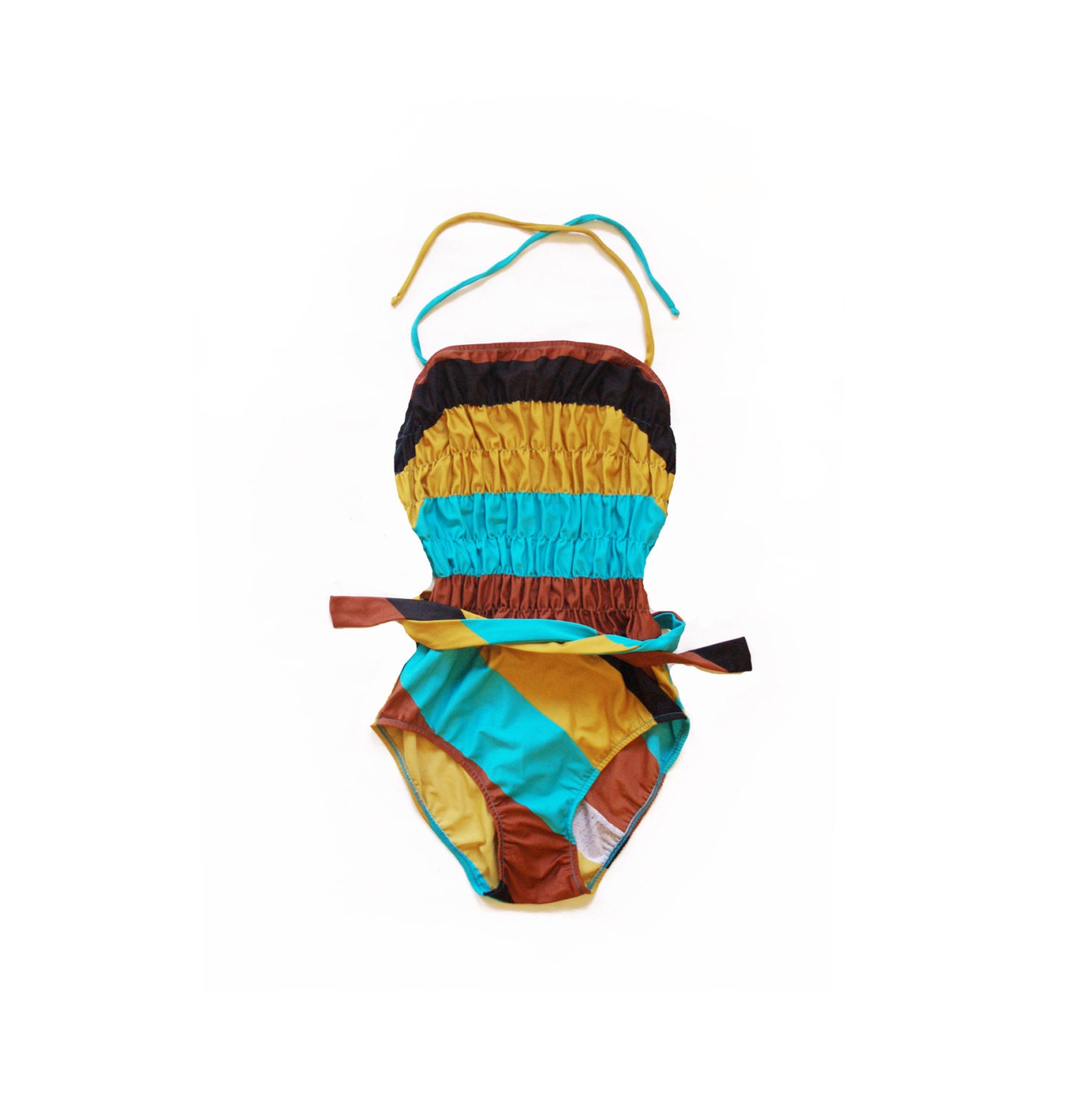
In Palm Beach County, you are a fool if you don't utilize the beach as much as possible.   Along with frequenting the beach, comes frequenting your swim suits.  In Texas, I only had one or two suits max. But here, being so close to the beach my beach fashions are stretched.   Which brings me to color blocking. 

This past Sunday, I had an impromptu trip to the beach.  When it came to what to wear, I had this old aqua bikini top that I wanted to wear, but no bottoms.  So I color blocked the aqua top with a solid brown bottom.  It actually looked fashionable.  To my surprise, I noticed quite a few women with color blocked swim suits; an orange top and nude bottom that was very stylish and sexy. Wait, no not like that!  Though I think the trend works well when you incorporate a color close to your skin color. 

What about color blocking away from the beach?

Color blocking is a national trend right now, and when out and about in West Palm you will see the trendy with color blocked clothes, shoes and nails.  In fact while I was out this week I saw someone who color blocked with a print and it looked quite fabulous.   Actually, I may see if I can incorporate a print alternative into my next attempt at color blocking.  

What do you think about the print addition to the color blocking?

Monday, July 29, 2013

Mani/Pedis


Not long after I moved to the Palm Beach area, I started to notice that EVERYBODY had, not just well manicured nails, but fashionable nails.  In WPB you can plan an outfit around the color on your toes.   Get the perfect sandals or strappy heels to go with that tangerine flirt.  Or perhaps, if you use the raspberry crush you have on your hands/feet as a splash color, you can plan outfits for both day and night in West Palm.  I recommend a large accessory like a scarf, belt or giant necklace. 
BCBGMaxazria Milan - Azalea
Strappy heels 
In West Palm Beach and in South Florida, one must splurge to maintain Hand and Foot fashion.  I am talking manicures and pedicures.  And what gal doesn't want to go to a nail spa to get pampered?  The massage chairs, the wine (if it's a classy place), all make it worth it. But it's more of a necessity in the land of the sun and sandals. It is acceptable to show your toes everywhere; even at work, which I disapprove of.   

If you can't afford the spa, that's no excuse girl.  Just spend a few dollars and get yourself a good color from the local drugstore and DIY.   You don't want to get caught at the beach looking like a reptile. I usually keep it simple with a nice nude, when going this route. Oh and don't neglect other hand/foot accessories such as bracelets, rings, etc. 

Thursday, July 25, 2013

Getting High: Aesthetic Flying

                Travelogues bog down in the mundane; griping about security lines and procedures, annoying fellow passengers, and the ever more intense provocations of travelers’ impatience.  But such inane prattle misses the proverbial forest for the trees: the tao of travel, as Paul Theroux calls it.  In other words, why travel at all if we fail to stop, breathe, and consider the journey along the way?
              
  In a world in which we are never out of touch for long, hurtling through the air at 350 miles per hour while above ground at 35,000 feet in what is essentially an aluminum tube can sometimes provide more intense considerations of sprawl, planning, and design than takes place at ground level in our day to day lives.
                Yet as South Floridians used to traveling in the opposite direction from the rest of the country, we sometimes ignore these heavenly encounters with our environment that generations ago would have been thought impossible.  As part of our ruminations to spur your thinking on such issues the next time you travel, consider a few favorite South Florida aerial highlights:

      1.    Should you be treated with a westward landing or an eastward takeoff from Palm Beach International, your views of the mansions and grounds of the estates on Palm Beach Island will be unsurpassed.  Will this be the closest in our lives that we get to the residences of the island, aside from ironing rich people’s shirts, cutting their grass, or mowing their lawns?  For that matter, we, the many lowly urban dwellers who live close to the airport pass by the private planes of the rich and famous every day.  Who has not seen the distinctive “T” Trump jumbo jet, or Vince McMahon’s smaller WWE executive jet? 
      Our own PBI provides perhaps a gentrified vision of a public airport unmatched anywhere in the county: our flights are notably less expensive and more plentiful out of Fort Lauderdale and Miami; when we see upgrades to the PBI landing tower we are no more moved than an updated lounge at Mar-a-Lago.  This time, instead of the high hedges of Trump International Golf Club signaling to the public to keep out, it is the market of high prices, the sea of private jets that signifies PBI is not for the masses, though we may live and work so close.
  
2.       Although not specific to Palm Beach County, who can still fail to marvel at the space shuttle launch pods at Cape Kennedy?  Native travelers to destinations in the north and east of this country will often be treated to an unrivaled view of the world famous space center. 
            In fact, one weekday afternoon flight to Washington D.C., I felt our cruising speed decrease. “Odd,” I thought, for this to happen in perfectly normal weather with no turbulence.  The pilot informed us that we were to witness the launch of a space shuttle.  Up out of their seats came those on the left side of the aisle.  And what a spectacle it was – an unobstructed view of man’s quest to reach the heavens, while viewing it from miles away, thousands of feet above the ground.

            3.   Flights in and out of PBI and Fort Lauderdale provide us with an unmatched opportunity to ponder the nature of the suburban sprawl we live amongst.  I talked to a New Yorker once, who said a friend of his just couldn’t get used the differences between the big city life and South Florida.  “Strip mall heaven,” I replied.
            Indeed, views on the long eastward landing pattern to Fort Lauderdale (ditto for PBI) give us a real-time spectacle of our pod-like suburban existence.  Each community, gated or not, demarcated with its roofs of similarly colored pates, shows the design of south Florida as envisioned for years.  The historical Palm Beaches site has some terrific comparisons of what used to be swamps or fields decades ago now transforming into American style suburbia.  Wellington, after all, used to be the world's largest strawberry patch.
            The point is not to lament or to praise this type of development - we will do so in future posts.  The point
is that an aerial view can bring home the point that this is where we are and how we have developed – there is no going back.  Can we learn lessons of smart development, or will each new sun belt city or metro area, growing as they are, suffer the same destiny of suburban, strip mall-centric development?

      So the next time your blood pressure rises thinking of your delayed arrival time, or cursing the crying baby preventing your slumber, grab a window seat and ponder.

Monday, July 15, 2013

Brutalist West Palm

   Visitors to the small downtown core of West Palm Beach are confronted with an incoherent jumble of visual and architectural styles to grab onto: faux Caribbean-style condominiums replete with the same pastel colors one might see in St. Thomas, Spanish colonial residences converted to offices, even a sprawling and depressing outdoor mall that is as unique as your local Wal-Mart.  (Cheesecake Factory? OMG!)

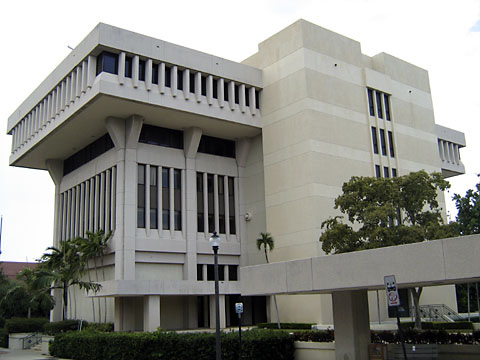
       Yet for all of the contrasting architectural styles comprising the relatively dull skyline, perhaps no hulk of metal, concrete, and glass provides as gripping a “stop and look” moment as the brutalist-style former West Palm Beach City Hall, opened in 1980.

          Beauty, as they say, is in the eye of the beholder.  And some commentators and readers will undoubtedly agree with the co-founder of this blog: “That shit is ugly.”  One can imagine visitors to the city wondering how the hulking mass, just steps from the intracoastal waterway, was ever approved in this subtropical context.  Alternatively evoking the image of an alien fortress, a prison, or some other guardian of the security industrial complex, the concrete old city hall will, at the very least, not engender apathy – viewers will either love or hate the style.
          Brutalist architecture has come under fire from a wide variety of sources.  Theodore Dalrymple, contributing editor to City Journal, for one, critiqued an exhibition dedicated to noted iconoclast Le Corbusier, arguing that “A Corbusian building is incompatible with anything except itself,” and likening brutalism to a form of architectural totalitarianism.
          In some respects, Dalrymple is correct: the brutalist old city hall does not appear to be designed with any of its surroundings in mind, heightening the appearance of a self-contained fortress at odds with the world.  To give a further example of the stark isolationist feel of the old city hall, compare for example one of the designs submitted for a redevelopment of the site from Song & Associates:


This proposal could not be more different from the existing brutalist building: in the proposal’s rendering, you actually notice that the site is close to the intracoastal waterway.  The sloping angles appear to be designed to direct attention to, give better views of, and incorporate the natural beauty of the intracoastal waterway, Palm Beach, and the ocean into the site as a whole.  Overall, the proposal looks harmonious with its surroundings and is generally consistent with what we might imagine when imagining a warm South Florida hotel site on the water in an urban context.
                When confronted with the juxtaposition between the friendly hotel proposal and the harsh city hall, consider the two schools of thought: on one hand, we could rage that our civic buildings should generate a feeling of friendliness and welcome and symbolize our government’s openness.

                I, however, beg to differ.  Brutalism, for this author, in the context of a government or civic building such as the old city hall, is the architect’s way of demonstrating in as outspoken and outrageously confrontational a manner as possible, that our city/country/state is muscular, robust, and doesn’t take any mess.  The highlighting of concrete and the deliberate contrast to the building’s surroundings speaks to me of a confident, unapologetic view towards the world: we are Man, we have conquered our surroundings, we are stronger than nature.  We do not need to be coddled; we are permanent.  Of course, my view directly conflicts with critics like Dalrymple who complain that concrete “does not age gracefully but instead crumbles, stains, and decays” and rail against brutalism’s alleged destructiveness.
              But just as the cascading upper echelons of art deco skyscrapers call to my mind the expression of an age in which anything was possible, in which we reached ever upward in our quest to modernize and perfect, and in which man had proudly industrialized, (cf. Detroit’s Penobscot building, at right), I do believe brutalism has a place, even in subtropical, cheesy, and corrupt West Palm Beach.  And although critics of the building’s style can quibble about its aesthetic beauty, our discussion necessarily leads to a more substantive and practical question regarding the building's successor - the sprawling new city hall complex on Clematis St.:

Is it more “brutal” to have a unique and statement-making building to represent your city tucked away on a relatively sleepy lot, or was it in fact more brutal for politicians to spend $154 million (in a city with 18% of people living below the poverty line) inexplicably placing the new city hall complex smack dab in the middle of a main commercial strip, replete with Saddam Hussein palace-style bathrooms, in the face of popular discontent?  Which is the true symbol of oppressive and totalitarian architectural and site design – brutalist structures, or brutally insensitive and inane politicians?