Showing posts with label architecture. Show all posts

Sunday, March 2, 2014

Caribbean Brutalism

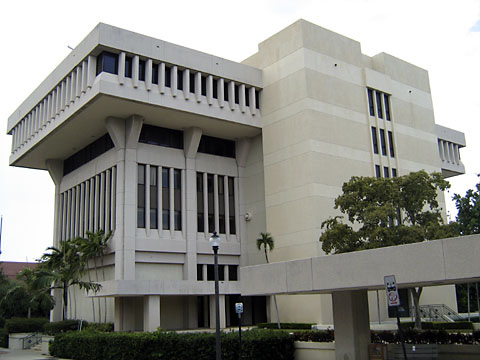
In discussing all things brutalist in the architectural commentary on our blog, we have not yet examined any hybrids of our favorite type of building.  Now, then, we bring you the aesthetic delight of the Virgin Islands Superior Court complex, to which we give hearty cheers:

I hesitate to argue that this is 1993 building is a brutalist hybrid of sorts.  But I think a case can be made that this complex does represent a combination of both Caribbean and brutalist influences.  The red roof with its Caribbean shapeliness certainly reminds one of typical St. Thomas dwellings (see below), and the structure itself, with emphasis on the concrete, with its strange third floor overhang, and its minimalist window arrangements, does remind us of more typical brutalist pieces.  I heartily approve of this rather cheery take on brutalism, and give you this study as evidence that brutalism does, indeed, continue to live on and influence architects even in our day.


Sunday, November 17, 2013

Albany is Brutal: Brutalism, Art Deco, and the Empire State Plaza

Attending a recent wedding for a longtime friend, I was pleasantly surprised at the architectural specimens to examine in Albany, New York's relatively unimposing skyline:

Who would think that this modest upstate town would hold a feast for the eyes of brutalism fans?

Consider, for example, the Empire State Plaza, directly across the street from the State Capitol.  This, I can tell you, is my kind of public space:


More closely resembling a North Korean parade ground, this concrete wonderland, laced by modernist buildings on all sides, naturally lead the pedestrian's eyes to the borderline brutalist Cultural Education Center.  Yes, even the name of the building replicates a militant, unapologetic governmental stance. A gathering place for the community, or an indoctrination center to praise the dear leader?

Even better, step back a few steps to the Northern entrance to the plaza, and look to your left and right: 
First, the Robert Abrams Justice center:

Who wants a justice building to look friendly and welcoming? Brutalism tells the man on the street: don't mess with Albany - we will crush you.

Turn your head and it's the suitably stark "legislative office building." (above). Wouldn't you shudder at the thought of trying to find a bureaucratic solution upon being faced with walking under the massive concrete slabs, or with trying to find your friendly state senator or representative to seek some redress? 

All the while, across the street behind you, you see where we came from, in the face of the ornate capitol building:

So on one end of the plaza we have the Capitol building, completed between 1867 and 1899.  And we have a plaza lined with stark 1970's modernist and brutalist timepieces.  So what about the time frame in between?  Just gaze up the street for a handsome art deco palace, the 1928 Alfred E. Smith State Office Building:

 So who would have thought, in Albany of all remote earthly places, we could encounter such impressive takes on modernism and brutalism, all within a stone's throw of some delicate antiques? Bravo, Albany, bravo.

Tuesday, October 22, 2013

Brutalism Part II

We at the FAD Palm Beach are proud to be ahead of the curve.  Our recent reappraisal of West Palm Beach brutalism may have surprised those who hate the concrete-laden architectural style. But as it happens, we are not alone - our discussion foreshadowed this interesting commentary from Slate:
Brutalism is probably what comes to mind when people are presented with the term high modernism in the context of architecture.
Three cheers to J. Bryan Lowder of Slate, then, for his erudite defense of brutalism. High modernism? Maybe. More likely, we just like to see buildings that look like alien fortresses.  Check out this beauty from Toronto - would you believe it's a library?

On a less serious note, we can also note the similarity between the Toronto library and the iconic Turkeytron character, of Aqua Teen fame:


Sunday, August 18, 2013

Palm Beach Architecture: Courthouse Divides Pt. III

                From the oldest origins of the neo-classical Miami-Dade courthouse, to the tropical decay brought to mind by the Fort Lauderdale courthouse, we bring you, finally, to 1994-built main courthouse in downtown West Palm Beach.  The WPB house of justice is perhaps a middle ground between the ancient origins of Miami-Dade’s courthouse and the new wave tropical decay of Fort Lauderdale’s.


Consider the attempt to give the pedestrian entryway from Dixie Highway some form of permanence: little stone monuments! Quotes! Wow!  Unfortunately, these “monuments” bear an unfortunate resemblance to road barriers.  No one could think of a more inspiring testament to our system of justice?


Consider also the symbolism of the arch at the top of the entryway between the two wings of the building: this rather overt walkway is symbolism by blunt instrument; an attempt to symbolize the openness of the justice system – come one, come all, you are welcome here.

                Yet for this critic, as you may have suspected gauging by my earlier commentary on the neo-classical Miami-Dade courthouse, the overall effect of the design strikes me as rather cheesy.  The arch, for all its pompous self-importance in the skyline of West Palm Beach, is something that beats you over the head.  Its supposed symbolism slaps your face, rather than the timeless pillaring and triangular designs of Miami.  
          Consider the effect of the building as a whole: [Special thanks to Mr. Keith Vincent of the fascinating www.courthousehistory.com website for allowing use of the image below].
           To this critic, this design calls to mind the 2000s, the era of the Rush Limbaugh pill trial, rather than the eternal struggle of truth - the quest for Western man to better himself - called to mind by timeless Greco-Roman columns of Miami.  The cheap attempt to replicate or imitate columnar shapes in the second levels do not inspire.

                I know there will be some in our audience who disagree – but we at the FAD Palm Beach will always err on the side of the classic-yet-never-outdated rather than siding with those who confuse a pretentious symbolism with weightiness.  

We at the FAD blog temporarily take leave of critiquing our public buildings.  But to those who think that architectural design in courthouses is a mere trifle, consider the timeless, evocative response felt by an earnest bankrupt in Honore de Balzac’s Cesar Birotteau, who can express the weight of our courthouses' symbolisms better than we ever could:

"To those persons who take society in its serious aspects, the paraphernalia of justice has a grand and solemn character difficult perhaps to define. Institutions depend altogether on the feelings with which men view them and the degree of grandeur which men's thoughts attach to them. When there is no longer, we will not say religion, but belief among the people, whenever early education has loosened all conservative bonds by accustoming youth to the practice of pitiless analysis, a nation will be found in process of dissolution; for it will then be held together only by the base solder of material interests, and by the formulas of a creed created by intelligent egotism......
It is a rare thing nowadays to find men who mount the stairway of the old Palais de Justice in the grasp of keen emotions. Cesar Birotteau was one of those men.....
Possibly the mind is sobered by a glimpse, caught through the rich gratings, of the Place du Palais-de-Justice, where so many sentences have been executed. The staircase opens above into an enormous space, or antechamber, leading to the hall where the Court holds its public sittings.
Imagine the emotions with which the bankrupt, susceptible by nature to the awe of such accessories, went up that stairway to the hall of judgment, surrounded by his nearest friends....."

We seriously doubt that the West Palm main courthouse could evoke such serious emotions among litigants and the public.  Which would be more likely to bring forth such gushing respect for a nation’s judicial institutions, the nondescript West Palm building which could just as easily be an office building, or the classic, neo-classical look of the Flagler courthouse?

Wednesday, August 7, 2013

Palm Beach Architecture: Courthouse Divides Pt. II

                Modernists and fans of innovation may quibble with our recent defense of neo-classicism.  It is easy to criticize these buildings: they are outmoded, designed for people of the average height in 1930, they signify an old, unjust power structure.  To these critics, then, a more reasonable example of a courthouse may be in Fort Lauderdale, where the courthouse lies just south of the riverwalk and the famous Las Olas Boulevard.
                Grayness of neo-classical marble may dissuade some; crowded, antiquated interiors may infuriate, and dated designs may symbolize only inconvenience for many.
                For this author however, the Broward County courthouse, modern though it may be, is a pathetic testament to the esteem in which we hold our justice system.  Avoiding all descriptions of architectural classification, consider the street view from the Southwest of the site:

Let's be honest: from this view, the courthouse resembles an abandoned tropical self storage facility.  The tiers above the top floor, with their window spaces open to the sky, remind one of something out of bombed-out Mogadishu, rather than a new, more equitable, modernity.
        And for the critics of neo-classicism who criticize the aging columns and marble which may turn gray over time, consider the scorched-earth appearance of the upper levels of this newer building.  Is that mold? The remnants of a fire? Whatever it is, it does not inspire me to some higher ideals of Western civilization and justice of our peers.   Rather, with the palm trees in front, it reminds me only of the tropical decay of a third world country.

                Most disconcerting, however, is the overall blandness of the design.  Ask the stranger or tourist on the street: “What is that building right there? Is it an office building? A warehouse?“ Whatever your average third party might say, they surely would not quip “It is clearly a public building, held in the highest esteem by the populace.”  In fact, at least from the most commonly used entrance for civil matters, the Southwest side of the site, the building almost completely blends in with its surroundings - despite the not as sleepy overall site design, seen at left.

And this failure to inspire from street level, in this critic’s opinion, is where the building’s design utterly fails.  A courthouse is not an office building – it is supposed to stand for some higher values or ideals.  Does an utterly non-descript building inspire anyone? 

From the FAD blog, then, we issue a sound thumbs down to the Broward County Courthouse.

Thursday, August 1, 2013

Courthouse Divides: Pt. I

        Perhaps nowhere more starkly do perceptions on architecture conflict than in our public spheres.  Consider, for example, all of the recent brouhaha over the Washington Mall.  MLK’s monument had to be “corrected” to delete the supposedly arrogant “I was a drum major” quote.  Plans for Eisenhower’s memorial have been criticized harshly, resulting in some to call for the outright revamp of the plans.

                It is with these controversies in mind, then, that we venture to comment on the architecture of our local courthouses, styles I am well familiar with having entered those halls of justice so often.  Comparing the state courthouses in the tri-county area is to relive the classic divide between traditionalists and the new.   

             Let’s begin with the Miami-Dade courthouse.  Venturing closer from the street level, you are confronted with a towering example of neo-classical features.  Sliced columns at the second level reminiscent of national buildings we are so familiar with, rising into the crowning triangular shapes of the pantheon.
             Coming closer to enter the hallowed space where lady justice reigns (as do sleazy attorneys; misogynistic judges who make comments on attractive court reporters; and bums sleeping across the street who keep their watchful eyes on the building), we pass through the columns that we often associate with neo-classical style.  At a height high above the ground, these columns may evince in some a feeling of feeling small in the face of authority; to others, they may signify the solemnity that we should feel when dealing in matters of life and liberty.

               
We even pass by a solemn statue of the man for whom the Miami-Dade courthouse is named, Henry Flagler.  


At one time, the courthouse was reputedly the tallest building in America south of Baltimore.     


              Traditionalists and fans of neoclassicism, then, will surely love the adhesion to timeless principles that are echoed in our most revered sites across the nation.  Haters of the style will likely see only symbols of our less equal past.
                
             This critic, for one, sides with the fans of the classic; it is one thing to advocate for new wave trends or for innovation in our commercial districts, but this author believes that nothing is lost, “Rien n’est perdu,” in the fearless new world words of Captain Nostromo, when we adhere to principles that remind the educated among us of the foundation upon which our Western system is founded.  Truth, liberty, justice – for this author, these principles are signified by the architectural parallels to the pantheon, by the impressive seeming permanence of the columns. 

              From the FAD Palm Beach then, we issue three cheers to the Miami Dade Courthouse, a rare and shining example of neo-classical architecture in our plasticky South Floridian midst.  Just as my co-blogger might say about fashion design & trends, I am of the persuasion that in architecture, we can never go wrong with the classics.

Monday, July 15, 2013

Brutalist West Palm

   Visitors to the small downtown core of West Palm Beach are confronted with an incoherent jumble of visual and architectural styles to grab onto: faux Caribbean-style condominiums replete with the same pastel colors one might see in St. Thomas, Spanish colonial residences converted to offices, even a sprawling and depressing outdoor mall that is as unique as your local Wal-Mart.  (Cheesecake Factory? OMG!)

       Yet for all of the contrasting architectural styles comprising the relatively dull skyline, perhaps no hulk of metal, concrete, and glass provides as gripping a “stop and look” moment as the brutalist-style former West Palm Beach City Hall, opened in 1980.

          Beauty, as they say, is in the eye of the beholder.  And some commentators and readers will undoubtedly agree with the co-founder of this blog: “That shit is ugly.”  One can imagine visitors to the city wondering how the hulking mass, just steps from the intracoastal waterway, was ever approved in this subtropical context.  Alternatively evoking the image of an alien fortress, a prison, or some other guardian of the security industrial complex, the concrete old city hall will, at the very least, not engender apathy – viewers will either love or hate the style.
          Brutalist architecture has come under fire from a wide variety of sources.  Theodore Dalrymple, contributing editor to City Journal, for one, critiqued an exhibition dedicated to noted iconoclast Le Corbusier, arguing that “A Corbusian building is incompatible with anything except itself,” and likening brutalism to a form of architectural totalitarianism.
          In some respects, Dalrymple is correct: the brutalist old city hall does not appear to be designed with any of its surroundings in mind, heightening the appearance of a self-contained fortress at odds with the world.  To give a further example of the stark isolationist feel of the old city hall, compare for example one of the designs submitted for a redevelopment of the site from Song & Associates:


This proposal could not be more different from the existing brutalist building: in the proposal’s rendering, you actually notice that the site is close to the intracoastal waterway.  The sloping angles appear to be designed to direct attention to, give better views of, and incorporate the natural beauty of the intracoastal waterway, Palm Beach, and the ocean into the site as a whole.  Overall, the proposal looks harmonious with its surroundings and is generally consistent with what we might imagine when imagining a warm South Florida hotel site on the water in an urban context.
                When confronted with the juxtaposition between the friendly hotel proposal and the harsh city hall, consider the two schools of thought: on one hand, we could rage that our civic buildings should generate a feeling of friendliness and welcome and symbolize our government’s openness.

                I, however, beg to differ.  Brutalism, for this author, in the context of a government or civic building such as the old city hall, is the architect’s way of demonstrating in as outspoken and outrageously confrontational a manner as possible, that our city/country/state is muscular, robust, and doesn’t take any mess.  The highlighting of concrete and the deliberate contrast to the building’s surroundings speaks to me of a confident, unapologetic view towards the world: we are Man, we have conquered our surroundings, we are stronger than nature.  We do not need to be coddled; we are permanent.  Of course, my view directly conflicts with critics like Dalrymple who complain that concrete “does not age gracefully but instead crumbles, stains, and decays” and rail against brutalism’s alleged destructiveness.
              But just as the cascading upper echelons of art deco skyscrapers call to my mind the expression of an age in which anything was possible, in which we reached ever upward in our quest to modernize and perfect, and in which man had proudly industrialized, (cf. Detroit’s Penobscot building, at right), I do believe brutalism has a place, even in subtropical, cheesy, and corrupt West Palm Beach.  And although critics of the building’s style can quibble about its aesthetic beauty, our discussion necessarily leads to a more substantive and practical question regarding the building's successor - the sprawling new city hall complex on Clematis St.:

Is it more “brutal” to have a unique and statement-making building to represent your city tucked away on a relatively sleepy lot, or was it in fact more brutal for politicians to spend $154 million (in a city with 18% of people living below the poverty line) inexplicably placing the new city hall complex smack dab in the middle of a main commercial strip, replete with Saddam Hussein palace-style bathrooms, in the face of popular discontent?  Which is the true symbol of oppressive and totalitarian architectural and site design – brutalist structures, or brutally insensitive and inane politicians?

FAD - Fashion of Palm Beach County

C.Z. Guest and Joanne Connelly, circa 1955, Palm Beach, Florida
Photo by Slim Aarons/Hulton Archive/Getty Images
Palm Beach County, is an untapped well for the fashion and art aficionado.  Palm Beach County ranks number nine out of counties with the most millionaires.  Where does one go to look at and be inspired by high fashion and art?  To an area with disposable income, an area like Palm Beach County.

Honestly, to find most of the millionaires in Palm Beach County one would need to venture to Palm Beach Island.  It has it's own culture of art and fashion. You can find fashion labels on Palm Beach Island, that you would normally only find in the big city.  Couture stores, Gucci, Pucci, Louis Vitton and the like are all located on this tiny sixteen mile island that has around 30,000 residents at most; during  snowbird season of course.

It's not just Palm Beach Island, West Palm Beach also has it's own flare when it comes to fashion and art.  Though West Palm Beach was once an area for the hired help, it has become an attraction for those who can afford vacation properties.  And those who can afford vacation properties, can also afford resort wear.

FAD will examine, highlight and focus on all aspects of fashion, art and architecture when it comes to Palm Beach County.  Not all fashion, art and architecture in Palm Beach County is created equal.

I am Giovanni aka Blamegirl and will be the fashion voice of this blog.  I have years of experience working in the fashion industry and will provide a unique voice when it comes to fashion in Palm Beach County.  I've recently relocated to the area from Texas and have observed a change in the fashion here.  

WELCOME

      Palm Beach County; home of transplants and natives of all kinds: east coasters, hippies, yuppies, snowbirds, billionaires, sleazeballs, immigrants, corrupt public officials, hangers-on, wannabes & never was’s, slicksters, hipsters, retirees, and freaks and geeks of all shapes and sizes.
     Into this cosmic slop of a melting pot we wade, having noticed the utter lack of erudite commentary on the bustling arts scene of our fair county.  In this vein we desire to highlight fashion, art, and architectural trends that may ordinarily be covered with only two or three lines in our local papers, or that may be ignored altogether.
     Viewed through the lens of someone relatively new to the local area, (having relocated here 5 years ago), I hope that my discussions will attract attention to the wide variety of artistic and architectural flourishes that we dwell among.  I plan to cover the totally overlooked unconventional and avant-garde scenes to the extent they exist, with a special emphasis on performance and guerrilla art, seeking out and championing absurdism in our daily lives.  Routine exhibition openings with the usual wine and cheese, as we know, grow stale.
     In contributing to the arts and architectural highlights of FAD Palm Beach, I am dedicated to the mission of installation artist Allan Kaprow, who declared “The line between art and life should be kept as fluid, and perhaps indistinct, as possible.”