Visitors to the small downtown core of West Palm Beach are
confronted with an incoherent jumble of visual and architectural styles to grab
onto: faux Caribbean-style condominiums replete with the same pastel colors one
might see in St. Thomas, Spanish colonial residences converted to offices, even
a sprawling and depressing outdoor mall that is as unique as your local Wal-Mart. (Cheesecake Factory? OMG!)
Yet for
all of the contrasting architectural styles comprising the relatively dull
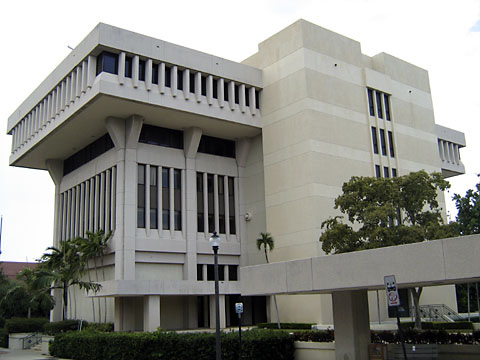
skyline, perhaps no hulk of metal, concrete, and glass provides as gripping a
“stop and look” moment as the brutalist-style former West Palm Beach City Hall,
opened in 1980.
Beauty, as they say, is in the eye of the beholder. And some commentators and readers will
undoubtedly agree with the co-founder of this blog: “That shit is ugly.” One can imagine visitors to the city
wondering how the hulking mass, just steps from the intracoastal waterway, was
ever approved in this subtropical context.
Alternatively evoking the image of an alien fortress, a prison, or some
other guardian of the security industrial complex, the concrete old city hall
will, at the very least, not engender apathy – viewers will either love or hate
the style.
Brutalist architecture has come under fire from a wide variety of sources. Theodore Dalrymple, contributing editor to City Journal, for one, critiqued an exhibition dedicated to noted iconoclast Le Corbusier, arguing that “A
Corbusian building is incompatible with anything except itself,” and likening
brutalism to a form of architectural totalitarianism.
In some
respects, Dalrymple is correct: the brutalist old city hall does not appear to
be designed with any of its surroundings in mind, heightening the appearance of
a self-contained fortress at odds with the world. To give a further example of the stark
isolationist feel of the old city hall, compare for example one of the designs
submitted for a redevelopment of the site from Song & Associates:
 T
This
proposal could not be more different from the existing brutalist building: in
the proposal’s rendering, you actually notice that the site is close to the intracoastal
waterway. The sloping angles appear to be designed to direct attention to, give better views of, and incorporate the natural
beauty of the intracoastal waterway, Palm Beach, and the ocean into the site as
a whole. Overall, the proposal looks
harmonious with its surroundings and is generally consistent with what we might imagine when imagining a warm South
Florida hotel site on the water in an urban context.
When
confronted with the juxtaposition between the friendly hotel proposal and the
harsh city hall, consider the two schools of thought: on one hand, we could rage
that our civic buildings should generate a feeling of friendliness and welcome
and symbolize our government’s openness.
I, however, beg to differ. Brutalism, for this
author, in the context of a government or civic building such as the old city
hall, is the architect’s way of demonstrating in as outspoken and outrageously
confrontational a manner as possible, that our city/country/state is muscular,
robust, and doesn’t take any mess. The
highlighting of concrete and the deliberate contrast to the building’s
surroundings speaks to me of a confident, unapologetic view towards the world:
we are Man, we have conquered our surroundings, we are stronger than nature. We do not need to be coddled; we are
permanent. Of course, my view directly
conflicts with critics like Dalrymple who complain that concrete “does not age
gracefully but instead crumbles, stains, and decays” and rail against
brutalism’s alleged destructiveness.
 B
But just as the cascading upper echelons of art deco skyscrapers call to my mind the expression of an age in which anything was possible, in which we reached ever upward
in our quest to modernize and perfect, and in which man had proudly
industrialized, (cf. Detroit’s Penobscot building, at right), I do believe
brutalism has a place, even in subtropical, cheesy, and corrupt West Palm
Beach. And although critics of the
building’s style can quibble about its aesthetic beauty, our discussion
necessarily leads to a more substantive and practical question regarding the building's successor - the sprawling new city hall complex on Clematis St.:
Is it more “brutal” to have a
unique and statement-making building to represent your city tucked away on a relatively
sleepy lot, or was it in fact more brutal for politicians to spend $154 million
(in a city with 18% of people living below the poverty line) inexplicably
placing the new city hall complex smack dab in the middle of a main commercial
strip, replete with
Saddam Hussein palace-style bathrooms, in the face of
popular discontent? Which is the true symbol
of oppressive and totalitarian architectural and site design – brutalist
structures, or brutally insensitive and inane politicians?



 This
proposal could not be more different from the existing brutalist building: in
the proposal’s rendering, you actually notice that the site is close to the intracoastal
waterway. The sloping angles appear to be designed to direct attention to, give better views of, and incorporate the natural
beauty of the intracoastal waterway, Palm Beach, and the ocean into the site as
a whole. Overall, the proposal looks
harmonious with its surroundings and is generally consistent with what we might imagine when imagining a warm South
Florida hotel site on the water in an urban context.
This
proposal could not be more different from the existing brutalist building: in
the proposal’s rendering, you actually notice that the site is close to the intracoastal
waterway. The sloping angles appear to be designed to direct attention to, give better views of, and incorporate the natural
beauty of the intracoastal waterway, Palm Beach, and the ocean into the site as
a whole. Overall, the proposal looks
harmonious with its surroundings and is generally consistent with what we might imagine when imagining a warm South
Florida hotel site on the water in an urban context. But just as the cascading upper echelons of art deco skyscrapers call to my mind the expression of an age in which anything was possible, in which we reached ever upward
in our quest to modernize and perfect, and in which man had proudly
industrialized, (cf. Detroit’s Penobscot building, at right), I do believe
brutalism has a place, even in subtropical, cheesy, and corrupt West Palm
Beach. And although critics of the
building’s style can quibble about its aesthetic beauty, our discussion
necessarily leads to a more substantive and practical question regarding the building's successor - the sprawling new city hall complex on Clematis St.:
But just as the cascading upper echelons of art deco skyscrapers call to my mind the expression of an age in which anything was possible, in which we reached ever upward
in our quest to modernize and perfect, and in which man had proudly
industrialized, (cf. Detroit’s Penobscot building, at right), I do believe
brutalism has a place, even in subtropical, cheesy, and corrupt West Palm
Beach. And although critics of the
building’s style can quibble about its aesthetic beauty, our discussion
necessarily leads to a more substantive and practical question regarding the building's successor - the sprawling new city hall complex on Clematis St.:

